

I have kept a list of restaurants that I have wanted to visit for many years now. I find it very useful as I am browsing through social media and discover places that people post about that look interesting; add it to ‘the list’ and then when diary and funds allow, you book the table. I did previously write a post about ‘the list’ nearly 10 years ago (it is customary here to bemoan the passing of the years… *contemplative face*). It is pleasing to look back at that ‘the list’ post and see how many I actually have been to – clearly having the list works. One restaurant that I have had on ‘the list’ for many years is Jacob’s Restaurant in Hamburg. If I’m honest, I can’t quite remember how and why it ended up there, I think I probably read an article about it a while ago at a time when I was working for a company that had an HQ in Hamburg.
Anyway, last month [note from the author: actually this was April 2022! I wrote this article nearly two years ago, but forgot to publish it! Not sure what happened there, better late than never I suppose…] we made a trip to Germany for the first time in three years to go and see my wife’s family in Berlin. I managed to arrange it so that we could quickly swing by Hamburg on the way. I wanted to go for a few reasons: firstly, I have always wanted to see one of my favourite paintings, Caspar David Friedrich’s ‘Der Wanderer über dem Nebelmeer’ (trans: the wanderer over the sea of fog) which is hung at the Hamburg Kunsthalle; secondly, we wanted to meet my wife’s cousin, who we hadn’t seen in nine years; but thirdly (and secretly most importantly), I finally got to cross off Jacob’s Restaurant off my list!

A German culinary institution steeped in history
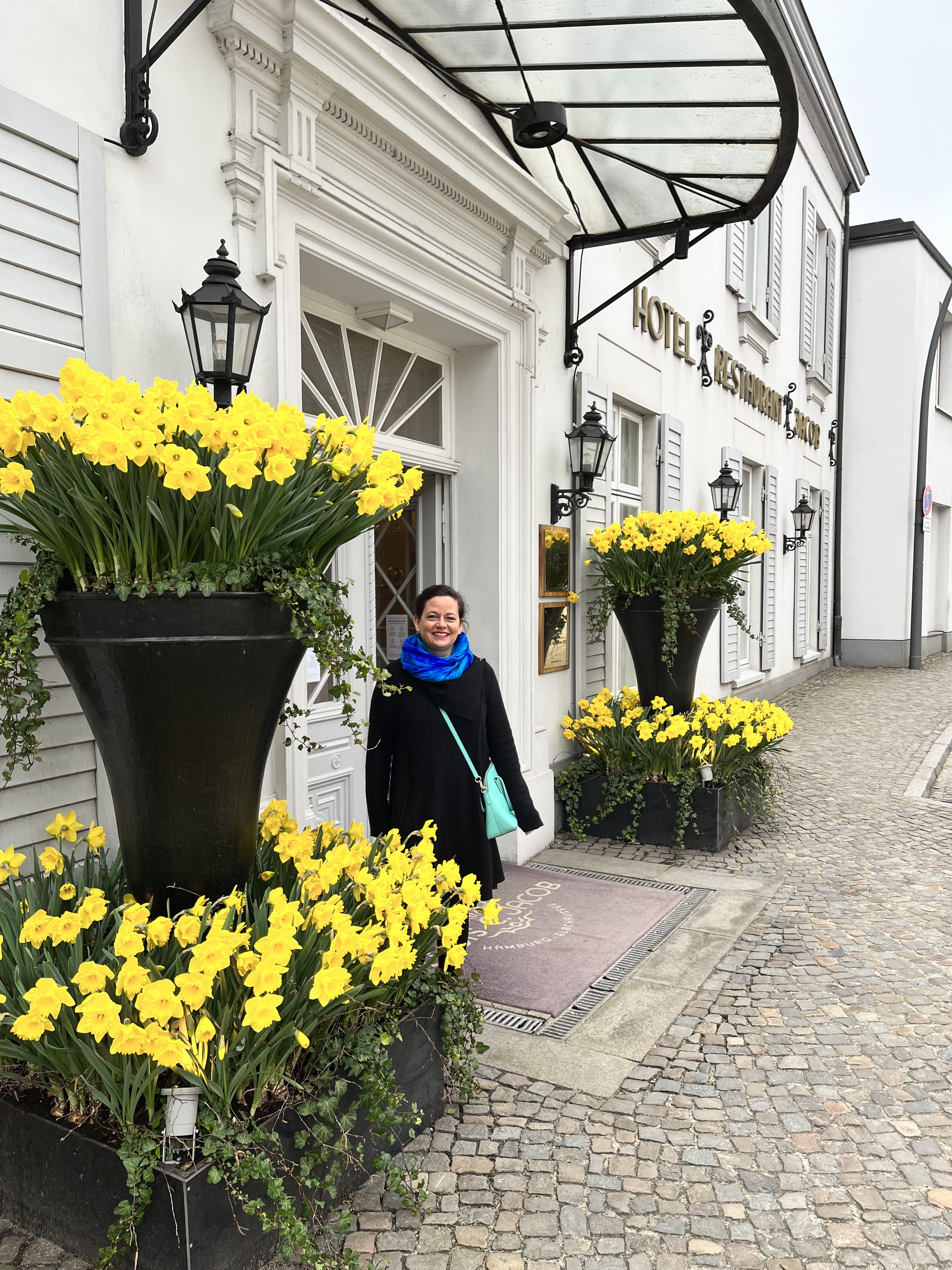
Jacob’s Restaurant is a German culinary institution. It is situated in the Louis C. Jacob Hotel, which can trace its history back to the eighteenth century. The hotel is not in Hamburg city itself, instead sitting comfortably in the leafy, well-heeled Elbchaussee suburb, on the banks of the river Elbe. It is an historic institution, attested to by this painting from Max Liebermann which captures the romantic ideal of wealthy Hamburg patrons taking tea overlooking the Elbe in Kaiser Wilhelm II’s pre-war Germany (we saw this picture in the Hamburg Kunsthalle too!).

Nowadays, the hotel retains its status and prestige. It still has its terrace, where you can luxuriate in the summer – when the notoriously temperamental Hamburg weather allows it… It has a main restaurant where its residents generally eat, but it also has a small fine-dining room where head chef Thomas Martin offers a tasting menu. Chef Martin is a German culinary star – up until 2020 his restaurant in Hotel Jacob held two Michelin stars. The dining room is set out charmingly in a very classical style – with tables affording nice views over the Elbe, although amusingly the other bank of the Elbe features an industrial-sized shipping container port – not the most salubrious of environs! The shipping containers do have a lovely view of the hotel though…
The meal
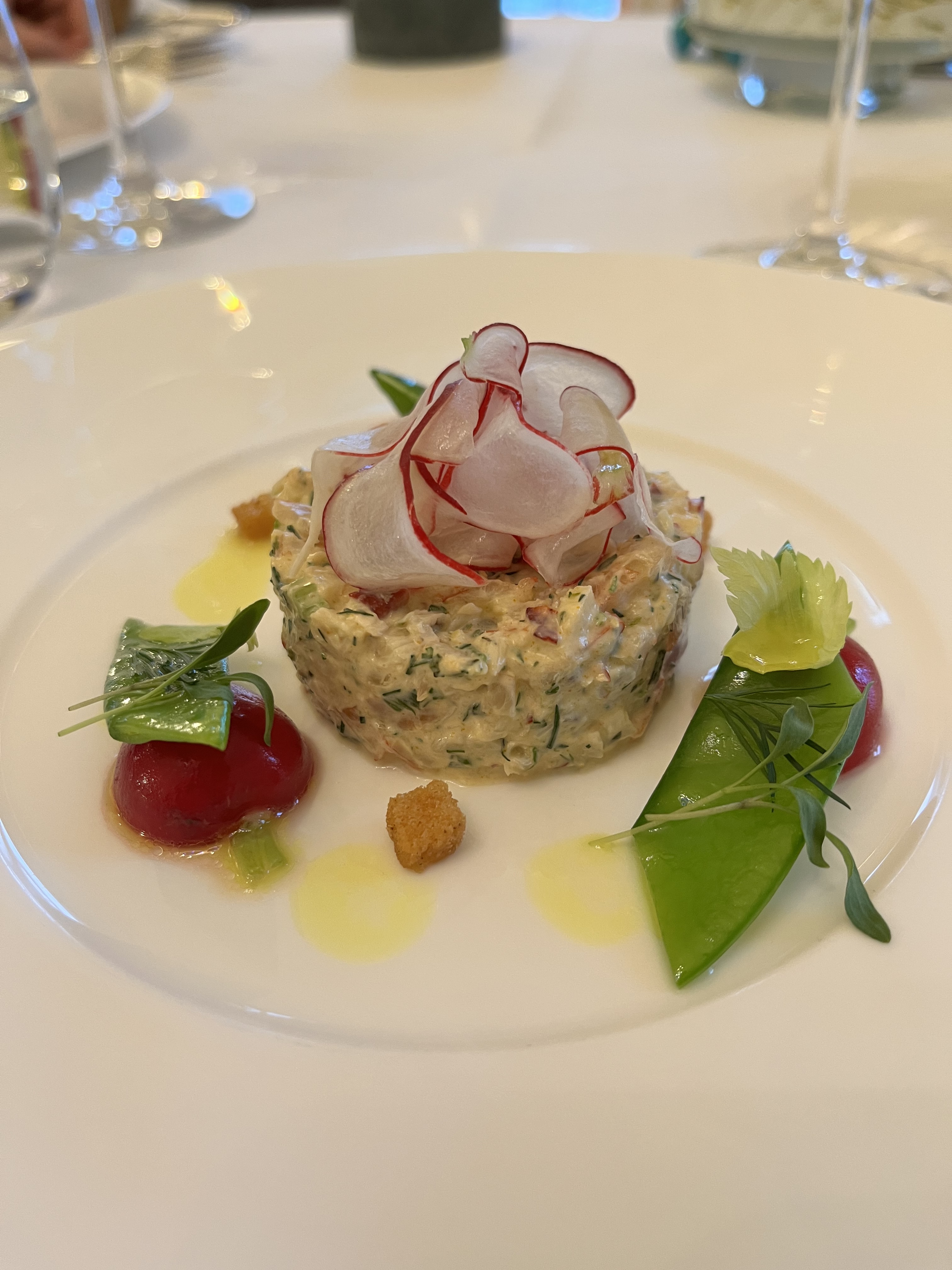
We went for a glass of NV Ruinart Blanc des Blancs, one of my favourite champagnes, as an aperitif, whilst we had our pre-menu amuse-bouches. The menu started with a salpicon of lobster served with a curry vinaigrette, radishes and snow peas (Salpicon vom Hummer mit Curryvinaigrette, Radieschen und Zuckerschoten). ’Salpicon’ is from the Spanish, somewhat pleasingly meaning a ‘hodgepodge’ or a ‘medley’. This was a bit like a ceviche, but without the citric acidity. The lobster was, as you would expect, deliciously succulent. I felt the genius here was the inclusion of the curry flavours, which gave the dish a richness and fragrance to contrast against the juicy lobster. This was further offset by the use of dill and the raw radishes. A dish full of contrasting flavours and textures, but the overall effect was pleasingly harmonious.
After this we had a glorious spring herb soup, served with sour cream and nasturtium (Samtsuppe von Frühlingskrautern, Sauerrahm und Kapuzinerkresse). The soup was poured into our bowl in front of us, submerging a treasure trove of morsels at the bottom of the bowl, that you discover as you eat it. Here, I really enjoyed the sour-cream in the soup which was itself strongly flavoured and quite punchy, so it really benefitted from the moderating presence of the sour-cream which gave it a bit of tang and richness.


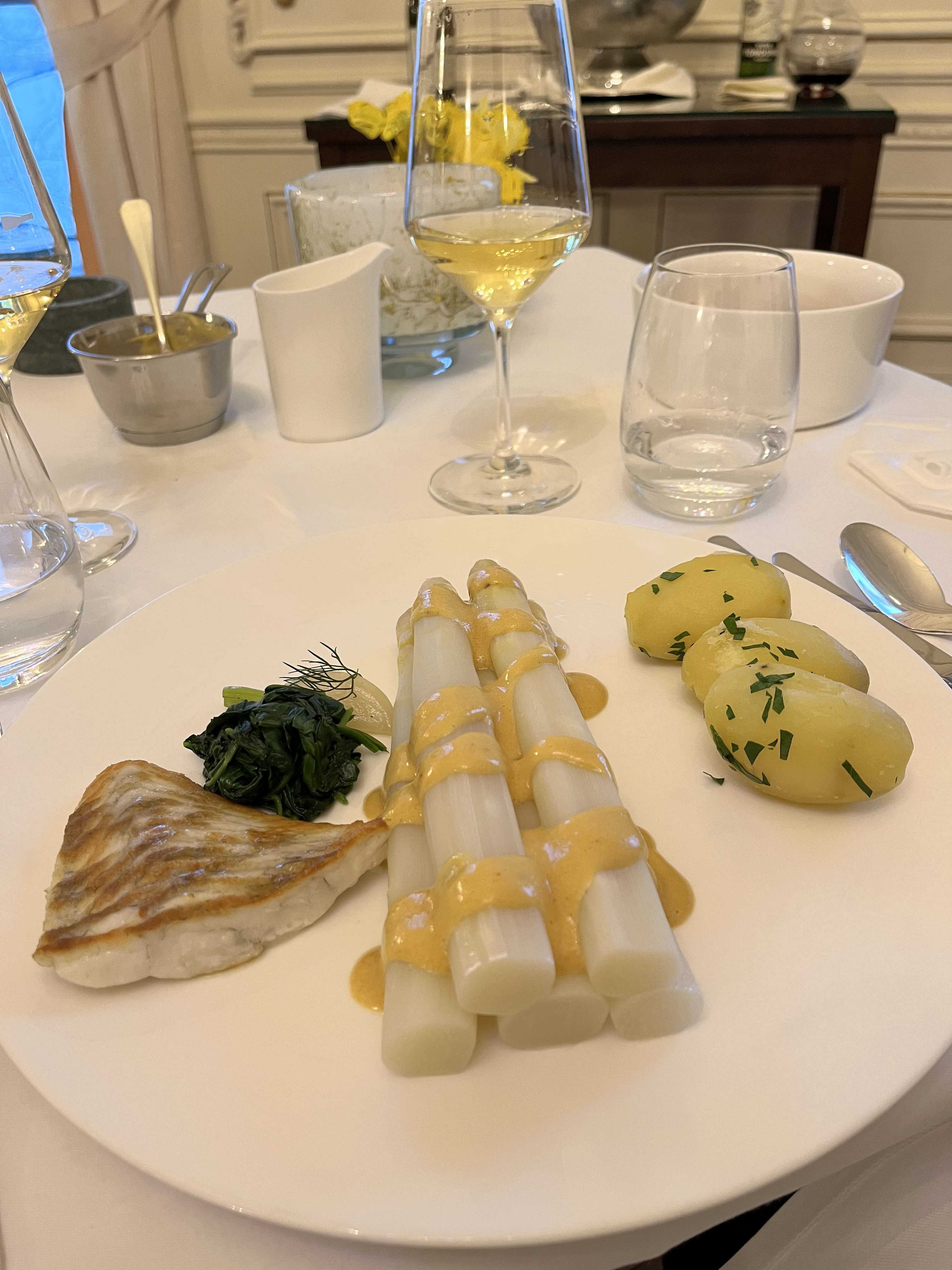
One the great joys of visiting Germany in the spring time is ‘Spargelzeit’ (lit: asparagus time). This is a period of celebration for Germans of the delicious white asparagus, which is a sauce of great national pride, and lasts between April and June. White asparagus grows under the ground, hence why it doesn’t turn green, and is referred to by Germans as “white gold”. When the special “Spargelkarte” came out with the current asparagus specials I knew that we were going to get some. I chose to have it with our fish course – roasted turbot, served with white asparagus, hollandaise sauce, parsley potatoes (Gebratenes Nordsee-Steinbuttfilet mit weißem Spargel, Sauce Hollendaise und Petersilienkartoffeln). Of course, the asparagus was delicious. Simultaneously soft in texture, whilst also retaining a bit of bite, it was heavenly with the hollendaise sauce. The turbot was nicely cooked too, a really meaty fish that made for a perfect foil to the Spargel – to my mind it did feel a little bit of a second-fiddle in comparison to the Spargel though.
When it came to the wine, I must say that I had excitedly pored through their wine list heading straight to their German Riesling section. I mean, when in Rome and all that. However, I was a little underwhelmed with their selection – nothing really grabbed me. Undeterred, I broadened my search a little and saw an exciting looking 2004 Weingut Bründlmayer Zöbinger Heiligenstein Riesling “Lyra” (Kamptal, Austria). This is a wine from a revered producer and I was keen to experience it from an older vintage, particularly as I’ve got cases of 2020s and 2021s laying down in my cellar waiting to be drunk.
As you would expect from a wine with nearly 20 years of ageing, the colour had gone to a lovely light gold. On the nose it was incredibly fragrant – stone fruit notes of apricot, but also sweeter notes of marmalade coming through. I also felt that it had a really floral, perfumed profile – maybe jasmine? On tasting I was not disappointed at all. The wine had perfect balance to it – some zippy citrus fruits kicking around showing that it still possessed its acidity, but offset with richer, slightly sweeter notes. Overall, I thought of something like a Seville orange marmalade. Huge finish, easily two minutes. Jajajajaja! Now, can I wait 20 years for my wines to reach this level of maturity??

For our meat course, we were served roasted shoulder of veal, served with tomato, pearl onions and saffron risotto (Geschmorte Kalbsschulter mit Tomate, Perlzwiebel und Sarfranrisotto). I did feel that this was one course that lacked a little bit in terms of visual appeal with the colours also looking a little garish. The taste, however, was gorgeous. The meat was unctuous and rich, with bags of flavour and the saffron risotto was rich and exotic. The sauce around the edge of the dish helped bring it all together and then the little pearl onions had a slight bite and tang to them, which rounded off the plate.
Last up was our dessert course – flambéed semolina, served with strawberry and rhubarb (Griesflammerie mit Erdbeeren und Rhubarben). A semolina pudding is a very German dish – for my wife it brought back plenty of memories of childhood for her. I must say that I found the consistency of the pudding a little odd, a tad grainy for my liking. However, the joy of the dish for me were the other elements on the plate – the rhubarb that still had its usual tang, the lush strawberry ice cream, the little meringue-style shard, the crumb underneath it all. All of thes favours and textures came together to give you something that served as a little prelude to summer. A reminder of what fun we have to come.


In summary…
So there you have it. A fantastic meal and another restaurant ticked off “the List”. I did very much enjoy the experience, the setting was grand, and the staff were lovely. I must note that I did have a couple of foibles about the meal. Most notably, I felt the dining room was at too hot. I think it must have been 23 or 24 degrees in there – other guests were fanning themselves at the table. It was a relatively cool evening overall so I’m guessing they’d put the heating on, but for me they’d gone way too far. I also thought that they left slightly too long between courses, which meant that the overall meal took nearly three hours.
That all being said, I would still encourage people to go to this landmark restaurant in an historic hotel, nestling prettily on the banks of the Elbe.
 timmilford.com