

We recently travelled to Paris, a city that I’ve passed through quite a few times recently (usually en route to Champagne) but not spent any real time in four over a decade. The occasion was to celebrate my wife’s birthday and I was on the lookout for a venue to suitably celebrate in. I did consider the ’showy’ option of the starred restaurant in the Eiffel Tower, but I quickly opted instead for Marsan par Hélène Darroze. Chef Hélène is one of the food scene’s absolute icons, and the fact that she is a woman made it an even more appropriate way to celebrate the wonderful woman in my life. I have wanted to eat at her 3* restaurant in London’s Connaught hotel for a little while, but haven’t managed to get there yet (plans may be afoot to put that right).
The restaurant is situated in Paris’ well-heeled Saint-German district (obviously most of Paris’ districts are well-heeled, but Saint-Germain feels especially so). After checking in with the Maître’D you are taken past the private dining rooms on the ground floor, to an attractive open-plan dining room on the first floor. You are immediately offered the opportunity to say hi to the kitchen – something I always appreciate; I get so excited seeing the staff who are going to cook you the amazing food, and I hope that they get something out of seeing our excited faces! We were then taken to our table which was generously sized and minimally decorated.
A visit from the champagne trolley…
As we were perusing the menu, I was delighted to see a champagne trolley be wheeled over towards us – “that will help!”, I thought. Given we were having a special meal, I pushed the boat out and got us both a glass of Krug 171éme edition. I had seen a friend post recently about her experiences at a Krug tasting and it made me yearn for a try of this exceptional wine – it had been years since I’d last had some! As soon as it was poured I remembered why I enjoyed this wine so much: the nose was unbelievably complex, it had those bready/briochey notes that you expect, but it was also offset with a perfume of white blossom. The citrus aspect gave off a decadent lemon tart profile. On the palate the perlage was just so fine and delicate; it had a firm, yet simultaneously elegant character. It seemed to be both confident and forward facing, yet at the same time not come across as brash or assertive. Just a stellar wine – I hope it isn’t such a long wait until my next experience with this pure joy-bringer.

The starters
As we were there for lunch we decided to show some restraint and opted for the six-course tasting menu (as opposed to the nine-course). After the usual snacks and amuse-bouche, our first major plate was ‘The “Belles du Marsan” white asparagus, just like “Madeleine de Proust”’, which was made of a carpaccio of white asparagus served on a bed of grilled crab meat and served in a Sabayon sauce (also known as a ’Zabaglione’ in Italian) flavoured with saffron from the Auvergene volcanoes. We were in the height of white asparagus season, which was why this dish features – the asparagus was cut unbelievably thinly and served raw, something I’d never thought you could do. The sauce was served thick like a hollendaise, but had more perfumed notes from the saffron, and was picked up with grinds of lemon rind which lifted the flavour somewhat.
Next up was something that I know will divide the crowd: ‘Duck Foie Gras provided by Robert Dupérier in Les Landes’. I think in reality that Foie Gras will be something that future generations will not accept any more and I am on the verge with it. Yes, it is absolutely delicious, yet the ethical challenges of its cruel production methods mean that it surely cannot be something we continue to consume. Hélène Darroze’s stated aim with Marsan is to celebrate the gastronomy of south-western France, where she is very proud to come from. Within the cuisine of this area, Foie Gras is certainly an important part of the culinary offering, which is why it makes sense in this setting. The Foie Gras was served confit in a terrine with Timur pepper, beetroot chutney, candied rhubarb, and some ‘crispy leaves’. You can see from the picture that this was presented beautifully with the dish possessing an impressive height, and an array or morsels to accompany the beautiful Foie Gras, which was smooth, rich, flavoursome, and decadent. This may be the last time I have Foie Gras and if so, it was a hell of a way to bow out. I really enjoyed the accoutrements that came with the dish – the ‘crispy leaves’ were beautifully presented root vegetable crisps in the shape of a leaf; they were almost too pretty to eat. Almost…


It’s bread and butter, captain, but not as we know it…
In between courses we were given some bread – however this was unlike any bread course I’d had before. First of all we were presented with a slice of focaccia which instead of being served with olive oil as you would expect, was served in the ‘south-western style’ with a bowl of duck fat…! Oh my! We then had a boule of sourdough, made freshly in the restaurant which was served with a special butter. The butter arrived on its own trolley and was treated with great reverence as it was served. Check out the gloves that the waiter is wearing to serve it! It’s probably a good thing that I don’t have bread like this all the time as I think it wouldn’t do my waistline much of a favour…
The main courses
After this we were on to our fish course where we had a dish called ‘Taking me back in times: seasonal salmon from Adour river’. This is a special salmon that you are only allowed to fish for two months out of every year, from the Adour river in [find out where]. The salmon was served with a smoked potato mousseline which was unbelievably rich and decadent, alongside a cream sauce that featured caviar. Astride the salmon fillet was an oyster leaf which proudly displayed a selection of spring flowers and herbs. The salmon fillet was beautifully cooked, as you would expect, with the skin having been charred on ‘bichotan’, which I believe is a special kind of charcoal. This felt like another dish that was both decadent and rich, as well as elegant and dainty. It takes considerable skill to present food in this manner.
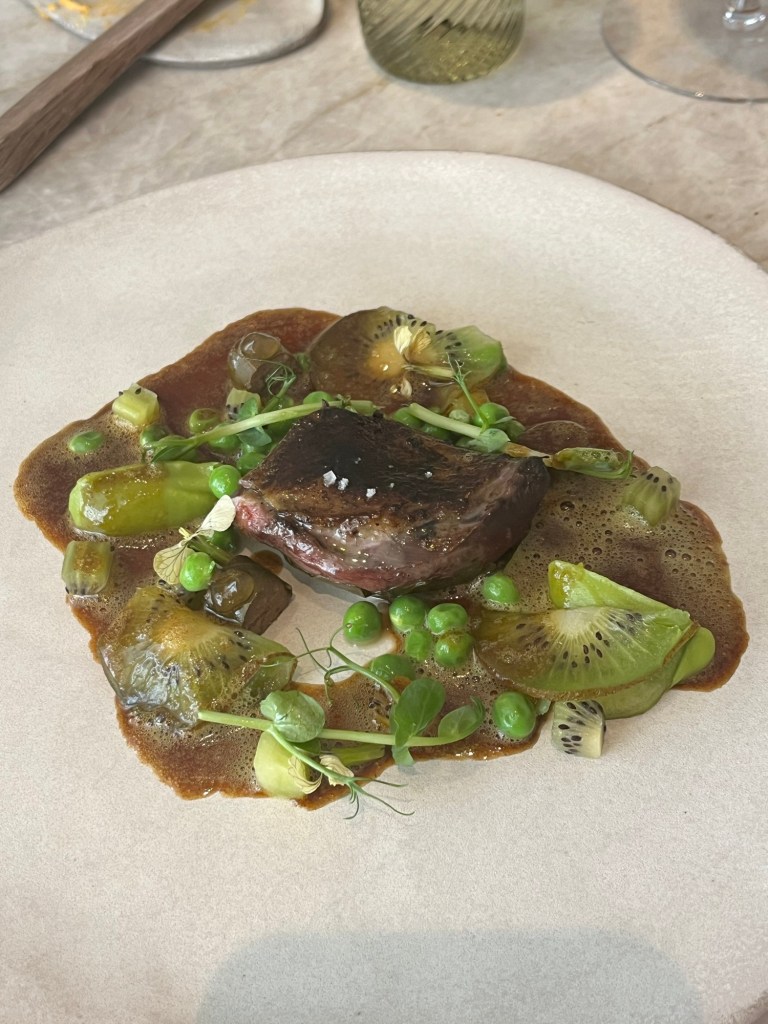
From the fish, we moved on to the meat course which featured ‘Pigeon from the Magesq like a spring brease [sic] in Kyoto’ which was cooked in a young cherry blossom leaf, and served alongside peas from Provence and kiwis from Adour with sakura flower. I think just from the description you can see that this was a complex dish, with a variety of influences at play. Firstly, you get the most beautiful and delicately cooked pigeon breast – perfectly pink in the middle, not at all on the rubbery side that you can get with overcooked game – simply perfection.
Alongside this you get a combination of Japanese and south-western French influences. I must admit, seeing thin slices of kiwi fruit on the plate did mess with my head a little – but it absolutely worked a wonder. The peas had a lovely structure to them, definitely on the al dente side of cooking, which gave the dish a bit of texture. Alongside the pigeon breast there were a few morsels of pigeon made from a mix of pigeon liver and wing meat, that gave the dish some slightly deeper, earth textures and flavours.

Le Vin…
At this point some of you may be wondering about the wine situation with the meal. In recent times I’ve taken to avoiding the accompanying wine flight as I sometimes feel you don’t get the best they have to offer, and you also end up drinking more. Instead, I have gone for picking an excellent bottle that you think will work across the menu. This is what I did here, going for a 2012 Paul Jaboulet Ainé ‘Domaine de Thalabet’ Crozes-Hermitage. I’ve been buying wines from Jaboulet en Primeur for a little while now and have a decent selection of these – both the Thalabet and also the ‘La Chapelle’ and from Hermitage. These wines were all brought to celebrate nieces’ and nephews’ births and to be brought out at their 18ths, so any excuse to drink some now to whet the appetite is welcome!
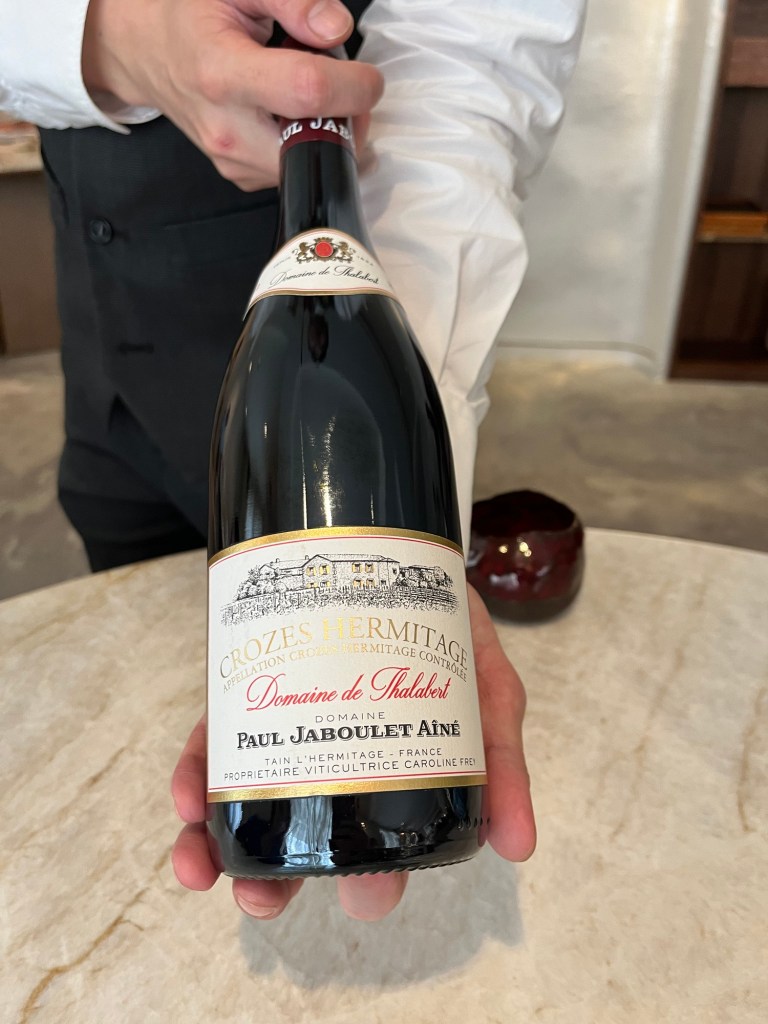
Despite being over a decade old, this bottle was still full of life and energy – in fact it was only in its teenage years in truth. The wine was inky and deep, with black cherry, beetroot, and tapenade flavours coming through. On tasting it was quite opulent, the tannins have all been nicely integrated now, leaving the wine to have a black fruit compote profile, offset with just a little smokiness. A fantastic wine, showing the class of the producer. I am already excited about the bottles I have yet to pull from my collection!
Les Fromages…
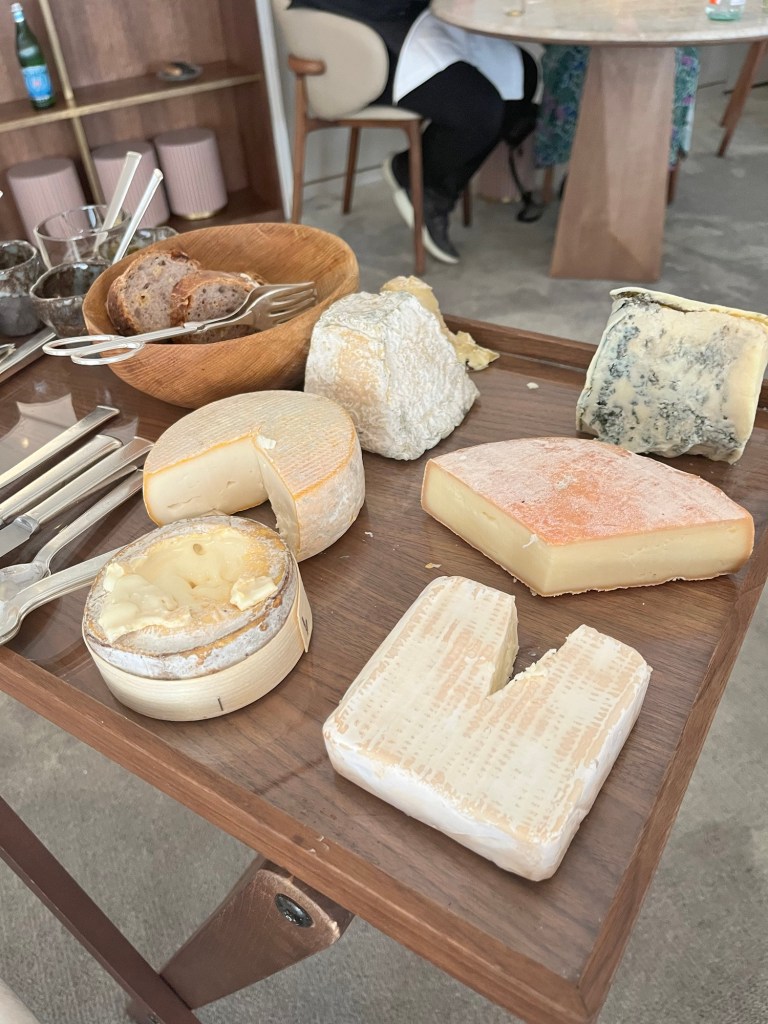
Before the desserts came I was offered the opportunity to take a look at the cheese trolley. You’re in Paris, so you’re not really going to turn that kind of opportunity down, are you? Each of the cheeses looked delectable so I allowed the waiter to offer me a selection. Each of the cheeses was from the Basque corner of south-west France / north-eastern Spain. My personal favourite from the selection was the blue cheese which reminded me a little of a Gorgonzola picante – it was a little bit spicy, a little bit salty, all with that delicious blue cheese tang. Just delicious!

Something sweet, but boozy, to finish
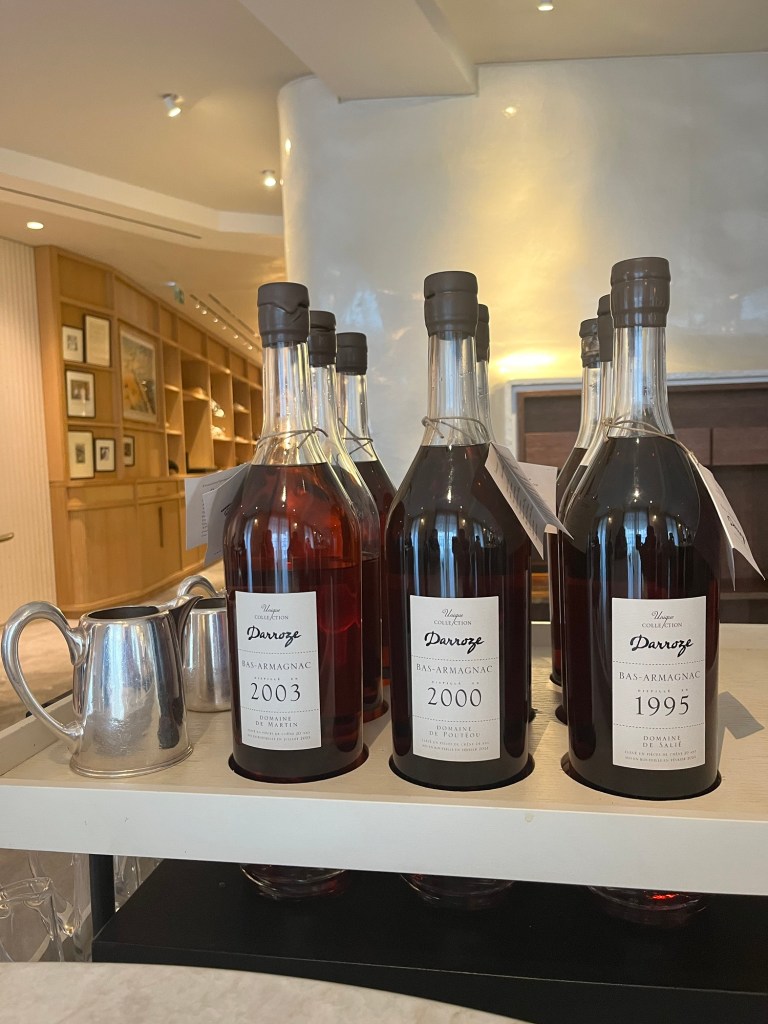
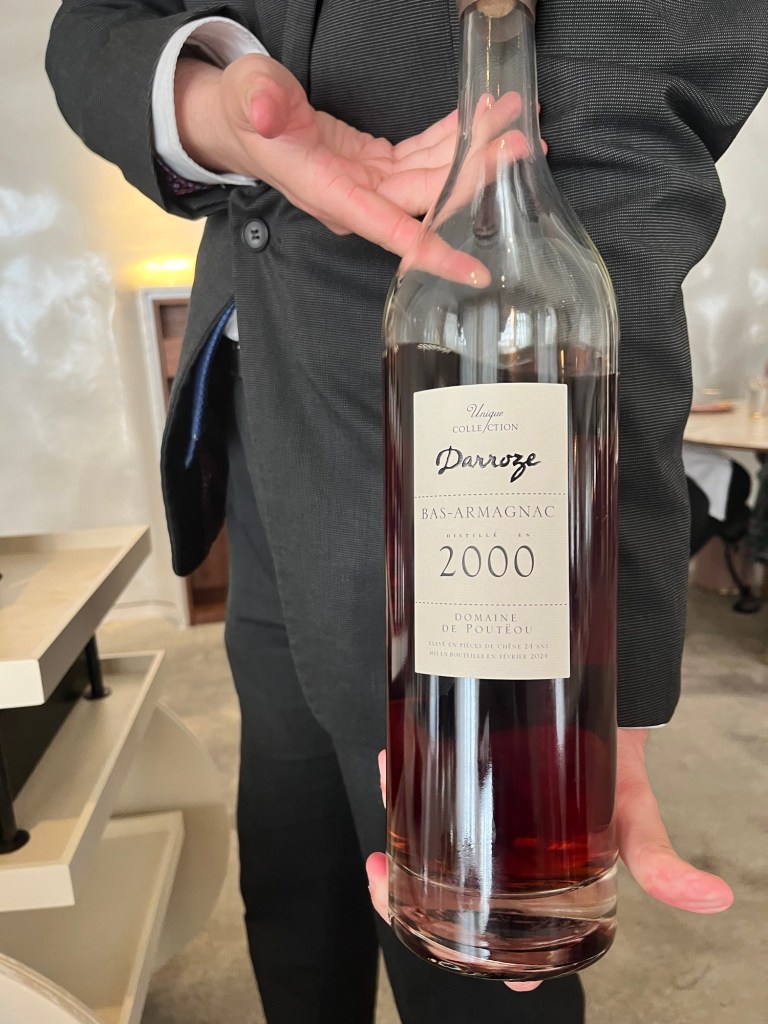
Now to dessert where there was a choice available. I went for the restaurant’s signature dessert “the Baba”. The Baba was bready and fluffy, and quite simple. The genius with it though was what it came with. Again a trolley was wheeled over, this time featuring a selection of Armagnacs made by Hélène’s brother, Marc. I was offered the choice of the 1995, 2000, and 2003 vintages; each of them had a slightly different profile. I preferred the 2000 it had some of the deeper notes on it, but still quite a lot of fruit and spice. It was then poured liberally over the Baba which soaked it beautifully with the fluffy pudding drinking it up. Alongside the boozy Baba there was a rich quenelle of Madagascan vanilla chantilly cream, alongside a Kiwi sorbet, which was served with a fennel vinaigrette and toasted fennel seeds. This added a temperature contrast to the dish, but also gave a little bit of acidic tang to the overall plate. A quite simply magnificent plate.

This rounded off the meal. It really was a superb experience. I felt that you could feel the love that chef Hélène has for her homeland of south-western France. It was a homage to the produce of that region, with ingredients being sourced from there with great care – and pride. This resulted in memorable combinations of flavours, as well as some unusual ones – like the use of kiwi fruit with the pigeon, which just worked brilliantly. In addition, I enjoyed the way that the names of the dishes on the menu told you a bit of a story, for instance: “Taking me back in time: the seasonal salmon of the Adour river, cooked on the skin on the bichotan, served with smoked potato mousseline, spring flowers and herbs, crème with caviar on an oyster leaf”. I don’t think I’ve seen a more evocative name for a plate on a menu – it both tells you a story and what you are going to get with the dish. The staff also did a great job of adding some flourishes and theatre to the way that the dishes arrived at the table, which added to the sense that you were eating somewhere right at the top-end of the gastronomic scene. The restaurant holds its 2* status very well. Certainly recommended if you are looking for a venue for a special meal.
 timmilford.com
Pingback: Exploring Hélène Darroze’s Award-Winning Cuisine at The Connaught | timmilford.com